Workforce Capability Building
Agentic AI Training: A Complete Guide to Building Responsible Workflows
· By AIHQ Team

The term "agentic AI" is appearing in more boardroom discussions, product roadmaps and industry headlines. But what does it actually mean for your organisation—and more importantly, how do you prepare your teams to build, deploy and manage these systems responsibly?
Unlike a standard chatbot or a tool that responds to a single prompt, an AI agent can reason, plan, use tools, take sequenced actions and work toward longer-term goals with less human step-by-step input. This shift from reactive tools to proactive agents introduces new possibilities—and new risks.
This guide explains what agentic AI is, why structured agentic AI training matters before deployment, and how organisations can build responsible workflows that balance autonomy with governance.
What Is Agentic AI?
Agentic AI refers to AI systems that can pursue goals with a degree of autonomy. Instead of generating a single answer, an agent can:
- Break down a user's objective into sub-tasks
- Decide which tools or data sources to call
- Take sequenced actions (e.g., query a database, draft an email, update a record)
- Self-correct when an approach does not work
- Pass control back to a human when escalation is needed
A familiar example is a customer support agent that can check an order status, verify a refund policy, draft a resolution and submit a ticket—without requiring the human agent to walk through each step manually.
Why Agentic AI Requires a Different Kind of Training
Tool-based AI training teaches people how to write prompts, use features and produce outputs. Agentic AI training must go further because the AI is taking action rather than just generating content.
Teams need to understand:
- Design thinking for agents: How to define goals, constraints, escalation paths and success criteria
- Tool selection and permissions: What an agent can access, query or modify
- Error handling and fallback logic: When an agent should stop, re-route or hand off to a human
- Traceability and logging: Why every agent action should be auditable
- Human-in-the-loop guardrails: Where and how to insert human approval steps
Without this structured preparation, organisations risk deploying agents that make incorrect decisions, access unauthorised data or escalate in ways that confuse customers and staff.
AIHQ has trained and engaged over 9,000 professionals across corporate, public sector and regulated environments. Structured capability building—whether for tools or agents—remains the foundation of safe and practical adoption.
The Core Components of Agentic AI Training
An effective agentic AI training programme should cover several layers beyond prompting basics.
1. Agent Architecture and Behaviour
Participants should understand how agents are structured. This includes the reasoning loop (observe, plan, act, evaluate), memory (how the agent retains context across steps) and the tools it can invoke. Training should clarify when an agent should act autonomously versus when it should ask for confirmation.
2. Workflow Mapping Before Agent Building
Before building any agent, teams should map the current workflow end-to-end. Where are the decision points? What information flows between steps? Where does a mistake cause the most impact? Training should teach participants to document workflows and identify which parts are suitable for agentic handling and which need human judgment.
3. Safety and Guardrails
This is the most critical layer. Agent safety training should cover:
- Input validation: How to prevent prompt injection or misuse
- Permission boundaries: What an agent is allowed to read, write or delete
- Escalation rules: Clear criteria for when the agent hands control to a human
- Output verification: How to check an agent's work before acting on it
Organisations should set clear guardrails for responsible AI use, especially around confidential or sensitive information. No agent should operate in production without defined boundaries.
4. Testing and Simulation
Agents behave differently in production than in controlled demos. Training should include simulation exercises where teams test agent responses across multiple scenarios—including edge cases, conflicting instructions and tool failures.
5. Monitoring and Continuous Improvement
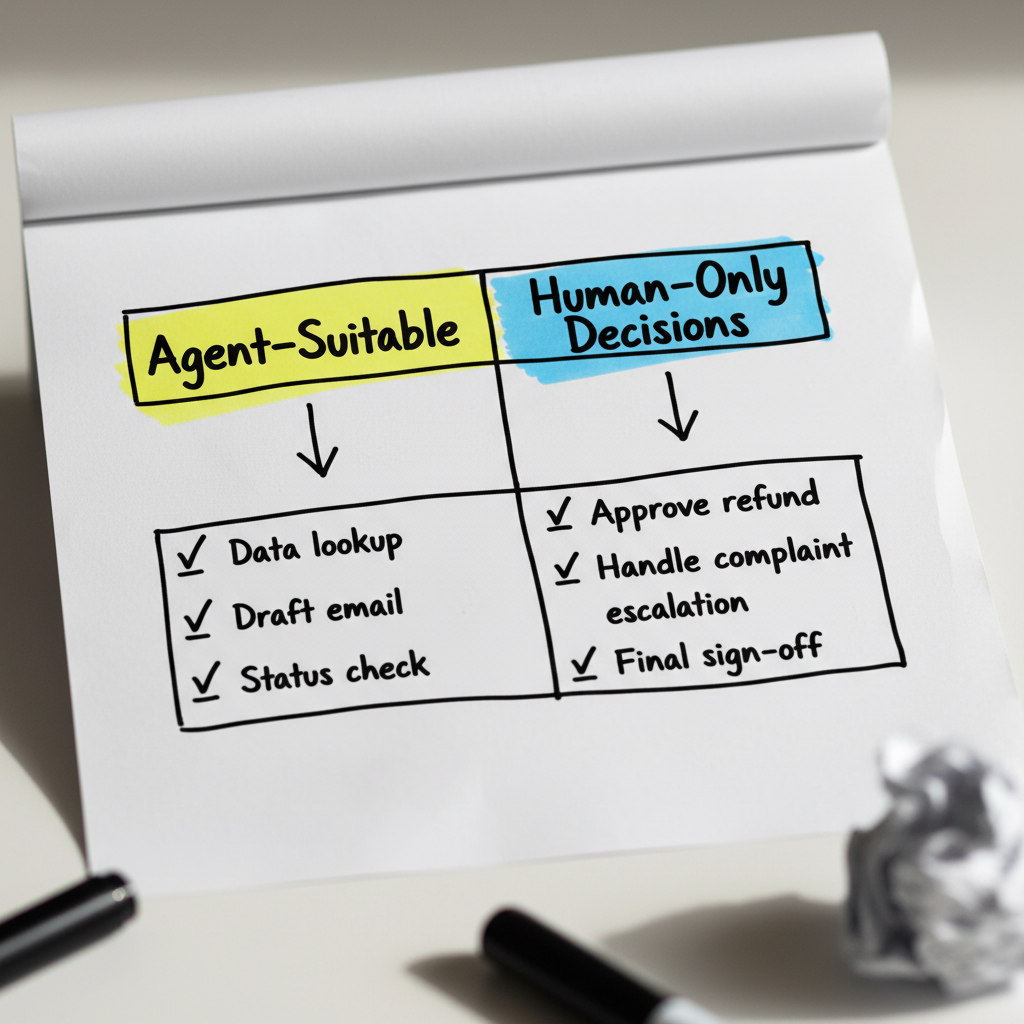
Mapping which tasks suit agentic handling and which require human judgment.
An agent in production needs observation. Training should introduce logging, performance metrics and review cycles so teams can detect drift, errors or unexpected behaviour before they cause harm.
Governance Is Not Optional
Agentic AI amplifies both productivity and risk. A misconfigured agent can send incorrect emails, update wrong records or expose internal data. That is why governance must be embedded into the training itself.
Key governance topics for agentic AI training include:
- Decision rights: Who approves what an agent can do?
- Data access policies: Which data sources are in-bounds and out-of-bounds?
- Audit trails: Can you review every action the agent took?
- Human oversight models: Continuous monitoring, exception-based review or periodic audit?
- Accountability: Who is responsible when an agent makes a mistake?
AIHQ's approach to AI governance helps organisations build safe AI adoption practices that translate policy into practical behaviour rather than a document that sits on a shelf.
How to Structure an Agentic AI Training Programme
A one-day workshop is unlikely to prepare teams for production agent deployment. A more practical structure looks like this:
Phase 1 — Foundations (1–2 sessions)
- What agentic AI is and is not
- Agent architecture fundamentals
- Risk awareness and safety principles
Phase 2 — Hands-On Workflow Design (2–3 sessions)
- Map a real workflow from your organisation
- Identify agent-suitable tasks vs. human-only decisions
- Design guardrails and escalation rules
Phase 3 — Simulation and Testing (1–2 sessions)
- Run the agent through realistic scenarios
- Practice handling failures and edge cases
- Document observed risks and adjustments
Phase 4 — Governance and Monitoring (1 session)
- Define logging and audit requirements
- Set review cadence and accountability
- Plan for ongoing observation and iteration
This phased approach mirrors how AIHQ works with organisations through structured capability journeys—moving from awareness to practical application with governance built in from the start.
Common Pitfalls to Avoid
Even well-intentioned teams make mistakes when adopting agentic AI. Here are the most common ones that structured training can help prevent:
| Pitfall | Why It Happens | How Training Helps |
|---|---|---|
| Over-automating too quickly | Excitement about agentic capabilities | Training emphasises workflow mapping before building |
| Weak guardrails | Assumption that agents make safe decisions | Safety and governance are core training modules |
| Skipping testing | Time pressure or overconfidence | Simulation exercises reveal failure modes early |
| Unclear escalation | No defined handoff criteria | Teams design escalation rules in training exercises |
| No audit trail | Agents treated like chat tools | Logging and traceability are taught as requirements |
When Off-the-Shelf Tools Are Not Enough
Some agentic workflows can be built using off-the-shelf AI tools. But when your organisation needs an agent that integrates deeply with proprietary systems, handles sensitive data or follows custom business logic, a generic solution may fall short.
In those cases, teams benefit from understanding the boundary between tool-based adoption and custom AI solutions. AIHQ helps organisations explore whether a custom agent, internal copilot or automated workflow is appropriate—and trains teams to build and maintain those solutions responsibly.
Off-the-shelf tools are useful, but some workflows require custom AI solutions, automation or structured implementation.
Getting Started with Agentic AI Training
If your organisation is exploring AI agents, here are practical first steps:
- Run a leadership alignment session to clarify strategic goals, risk appetite and governance expectations before any technical work begins.
- Audit one workflow end-to-end to identify where autonomy adds value and where human judgment is irreplaceable.
- Start with a small, low-risk pilot rather than a department-wide rollout.
- Invest in structured training that covers design, safety, governance and testing—not just tool features.
- Define observation and review processes before the agent goes live.
AIHQ supports organisations at each stage of this journey, from leadership alignment and role-based training to responsible AI governance workshops and custom solution design.
Conclusion
Agentic AI is a meaningful shift in how organisations can use AI—moving from answering questions to taking action. But autonomy without structure introduces risk. The organisations that benefit most from agentic systems will be those that invest in structured agentic AI training, build governance alongside capability and treat safety as a design requirement rather than an afterthought.
The goal is not to deploy agents quickly. It is to deploy agents responsibly, with teams that understand what they are building, why they are building it and how to keep it safe in production.
FAQ
What is agentic AI in simple terms?
Agentic AI refers to AI systems that can pursue goals with some degree of autonomy. Instead of just responding to a single prompt, an agent can plan steps, use tools, take sequenced actions and self-correct. Think of it as an AI that can work toward a goal rather than just answering a question.
Is agentic AI training different from regular AI training?
Yes. Regular AI training typically focuses on prompting, tool usage and output generation. Agentic AI training must also cover agent design, workflow mapping, tool permissions, error handling, escalation logic, safety guardrails, logging and human oversight—because the AI is taking action rather than just generating content.
What are the biggest risks of deploying AI agents without proper training?
Common risks include agents accessing unauthorised data, making incorrect decisions without human review, escalating issues incorrectly, or operating without audit trails. Structured training helps teams design guardrails, define escalation rules and build monitoring processes before deployment.
How long does it take to build agentic AI capability in a team?
It depends on the team's starting point and the complexity of the workflows involved. A phased programme typically spans several sessions—covering foundations, hands-on workflow design, simulation and testing, and governance—rather than a single workshop.
Can off-the-shelf AI tools handle agentic workflows?
Some basic agentic workflows can be built with off-the-shelf tools. However, workflows that require deep system integration, sensitive data handling or custom business logic may need a tailored approach. AIHQ helps organisations assess whether off-the-shelf tools are sufficient or whether custom AI solutions are more appropriate.
What governance practices should be in place before deploying AI agents?
Organisations should define decision rights, data access policies, escalation rules, human oversight models and audit trail requirements before an agent goes into production. These guardrails should be embedded in training so teams understand not just how to build agents, but how to operate them safely.