General
AI Chatbot Malaysia: How Local Businesses Are Deploying Smart Assistants for Growth
· By AIHQ Team

Walk into any Malaysian retail store, bank branch, or service centre today, and you are likely to encounter an AI chatbot before a human. From answering late-night product queries to routing insurance claims, chatbots have moved from novelty to necessity.
But here is what most articles will not tell you: deploying an AI chatbot in Malaysia is not about picking the trendiest tool. It is about matching the right chatbot type to the right workflow, handling Bahasa Malaysia and English naturally, and keeping a human in the loop when things get complex.
This guide covers six practical ways Malaysian businesses are using AI chatbots right now, the platforms worth evaluating, and what to watch out for before you deploy.
1. Customer Support — Reducing Wait Times Without Cutting Corners
The most common and visible use case for an AI chatbot in Malaysia is frontline customer support. Businesses in retail, telecommunications and banking are using chatbots to handle tier-one enquiries that would otherwise flood phone lines or email inboxes.
What it looks like in practice:
- A retail chain deploys a chatbot on its website and WhatsApp Business channel to answer store hours, stock availability and return policy questions.
- A telco uses a chatbot to handle plan enquiries, bill payment confirmation and basic technical troubleshooting.
- A bank runs a chatbot that helps customers check account balances and recent transactions without logging into the full app.
The benefit is faster response times — often under 10 seconds — and fewer repetitive questions reaching human agents. The catch? Chatbots need to handle Bahasa Malaysia and English naturally, and users must be able to escalate to a human agent when needed.
Tip for Malaysian businesses: Your chatbot should recognise "saya nak tanya pasal bill" as naturally as "I have a question about my bill." Language coverage matters for adoption.
2. Lead Generation and Sales Qualification
Beyond answering questions, AI chatbots are becoming competent sales assistants. Malaysian property developers, automotive dealers and insurance agencies are using chatbots to qualify leads before a salesperson picks up the phone.
How it works:
A visitor lands on your website or sends a message on WhatsApp. The chatbot asks qualifying questions — budget range, timeline, preferred location for property, or vehicle model interest. Based on the responses, it scores the lead and routes hot leads directly to the sales team while nurturing cooler leads with automated follow-ups.
Real example from the Malaysian market:
Property developers in the Klang Valley have reported that chatbots can engage prospects 24/7, capturing interest outside business hours when many working professionals browse properties. The chatbot books showroom appointments and collects contact details so sales teams walk into every meeting with context.
This works because the chatbot does not replace the salesperson — it replaces the form-filling and back-and-forth that slows down initial engagement.
3. Internal Employee Support and HR Enquiries
AI chatbots are not only customer-facing. Malaysian organisations with distributed workforces — retail chains with outlets nationwide, manufacturing plants, or service teams across multiple states — are deploying internal chatbots to help employees access HR information quickly.
Common internal use cases:
- Checking leave balances and submitting leave requests
- Accessing company policies and SOPs
- Submitting IT tickets or maintenance requests
- Finding training schedules and HRDC claim information
An internal chatbot reduces the burden on HR and IT teams, who often answer the same questions repeatedly. Instead of emailing HR to ask "how do I apply for medical leave?", an employee asks the chatbot and gets an answer in seconds.
What to watch out for: Internal chatbots handling sensitive employee data must follow clear data governance rules. Not all off-the-shelf tools are safe for confidential HR information.
4. Appointment Booking and Service Scheduling
Malaysian service businesses — clinics, automotive workshops, salons, and professional services firms — are using AI chatbots to manage appointment bookings conversationally.
The workflow:
A customer messages the business on WhatsApp or the website. The chatbot checks availability, suggests time slots, confirms the booking and sends a calendar reminder. If the customer needs to reschedule, the chatbot handles that too.
This sounds simple, but it eliminates the back-and-forth phone tag that frustrates both customers and reception teams. For multi-location businesses, the chatbot can also route the customer to the nearest branch.
5. Multilingual Customer Support — Bahasa Malaysia, English, Mandarin and More
Malaysia's multilingual environment makes chatbot deployment more complex than in English-only markets. A chatbot that only handles English will frustrate a significant portion of users.
Leading AI chatbot platforms now support Bahasa Malaysia, Mandarin and Tamil alongside English. However, language support varies significantly by platform. Some handle Bahasa Malaysia conversationally well; others translate mechanically, producing awkward responses.
Practical consideration for Malaysian businesses:
- Test your chatbot in all languages your customers actually use
- Allow users to switch languages mid-conversation
- Train or fine-tune responses for industry-specific terms in Bahasa Malaysia
- Keep human escalation available for language edge cases
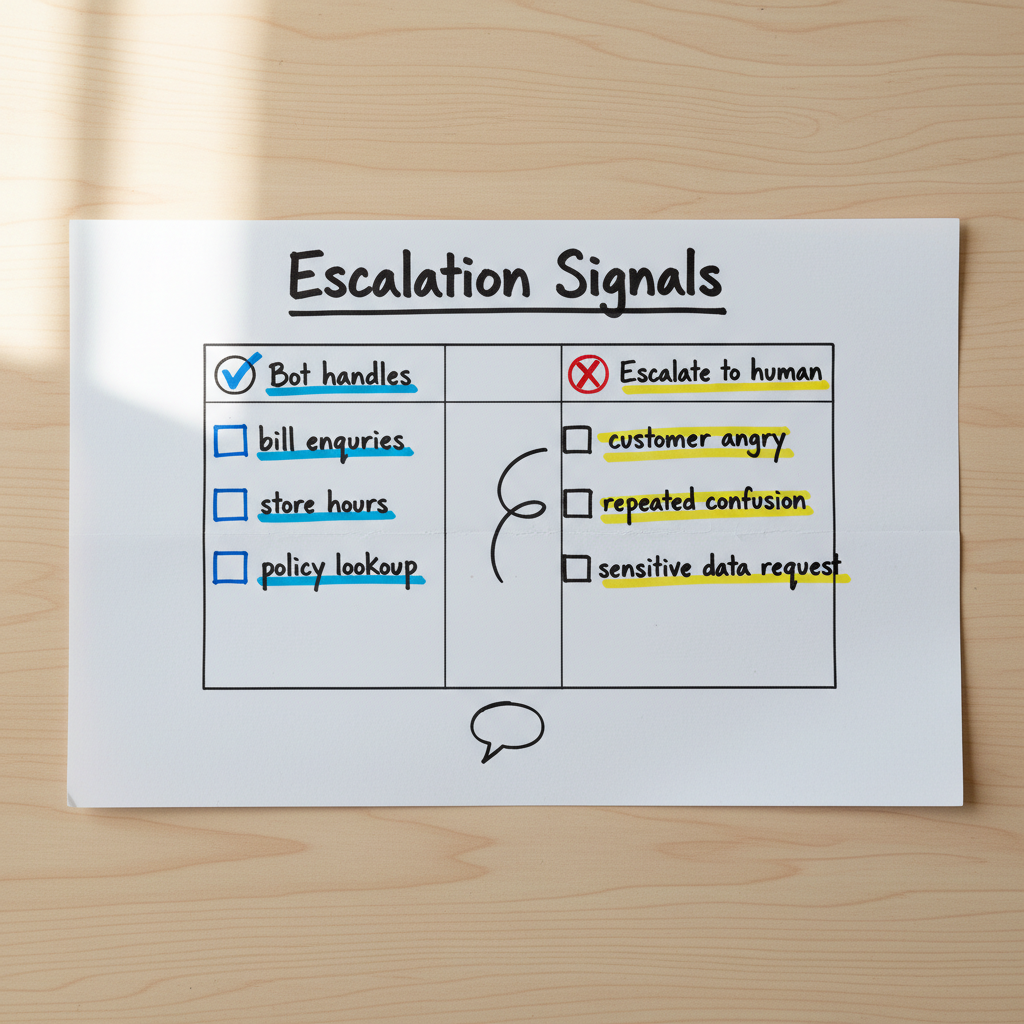
AI chatbots handle routine queries and escalate sensitive or complex cases to human agents
A chatbot that stumbles on language will erode customer trust faster than no chatbot at all.
6. Escalation-Aware Support — When the Chatbot Knows Its Limits
The most mature AI chatbot deployments in Malaysia are not trying to replace humans. They are designed to recognise when a conversation needs human judgment and escalate smoothly.
Signals that trigger escalation:
- Customer expresses frustration or types aggressively
- The query involves a complex complaint or refund request
- The chatbot cannot confidently answer the question
- The customer explicitly asks to speak to a human
When escalation happens, the chatbot hands over the full conversation context — what was asked, what was tried, and where the chat left off. This avoids the customer having to repeat themselves, which is one of the most common frustrations with automated support.
Good practice: An AI chatbot Malaysia deployment should always include an escalation path. The goal is to handle the routine so humans can focus on the complex.
Platform Options for Malaysian Businesses
Not all AI chatbot platforms are created equal, and the best choice depends on your workflow, language requirements and data privacy needs.
| Platform Type | Best For | Considerations |
|---|---|---|
| Off-the-shelf chatbot builders (e.g., Tidio, ManyChat, Zendesk AI) | Small to medium businesses, simple FAQ and lead gen | Limited customisation, may not handle Bahasa Malaysia well out of the box |
| Enterprise platform chatbots (e.g., Zendesk, Intercom, Salesforce Einstein) | Larger teams with existing CRM | Higher cost, stronger analytics, better escalation routing |
| Custom-built AI chatbots | Unique workflows, complex logic, specific language needs | Higher upfront investment, but tailored to your exact processes |
| WhatsApp Business API chatbots | High-reach customer engagement in Malaysia | Subject to Meta's approval and policies; strong for conversational commerce |
For many Malaysian businesses, an off-the-shelf chatbot is a good starting point. But when the workflow gets complex — multilingual nuance, industry-specific terminology, integration with legacy systems — a custom AI chatbot often outperforms a generic solution.
What to Watch Out for Before Deploying
Deploying an AI chatbot in Malaysia comes with practical risks that are worth planning for upfront.
1. Data privacy and PDPA compliance. Your chatbot will collect personal data — names, phone numbers, perhaps even ID numbers or financial information. Ensure your chatbot platform stores data in a compliant manner and that your privacy policy covers chatbot interactions.
2. Bahasa Malaysia language quality. Not all platforms handle Bahasa Malaysia conversationally. Run real-world tests before committing. A chatbot that answers in broken Malay will frustrate users.
3. Human handoff design. Escalation must be seamless. If a customer needs a human and the chatbot keeps them in a loop, you will lose their trust.
4. Scope creep. It is tempting to give your chatbot too many responsibilities at once. Start with one clear use case — customer FAQ, lead qualification, or internal support — and expand once you have validated the workflow.
5. Vendor lock-in. Some chatbot platforms make it difficult to move your data or customisations elsewhere. Evaluate portability before you build extensively on one platform.
When a Custom AI Chatbot Makes Sense
For many Malaysian businesses, an off-the-shelf chatbot handles the basics well enough. But there are clear signs you may need a custom approach:
- Your workflows involve complex conditional logic or multi-step approvals
- You need deep integration with legacy or internal systems
- Your industry uses highly specific terminology that generic models handle poorly
- You operate in a regulated sector with strict data and compliance requirements
- Bahasa Malaysia, Mandarin or Tamil support must be nuanced and industry-accurate
A custom AI chatbot built around your specific processes will outperform a generic tool in these scenarios. However, the upfront effort is higher, so it is worth validating the need first through a structured use-case discovery process.
Getting Started with an AI Chatbot in Malaysia
If you are evaluating an AI chatbot for your Malaysian business, here is a practical starting path:
- Identify one clear workflow — customer FAQ, lead qualification, internal support, or booking — and scope it tightly.
- Choose a platform that matches your complexity and language needs. Start simple if you are new to chatbots.
- Build a prototype and test it internally before exposing it to customers.
- Set up escalation — define what triggers a human handoff and ensure context is passed along.
- Review and refine — track what users actually ask, fix gaps, and expand scope gradually.
For teams that want to move faster, AIHQ supports organisations through the entire process — from identifying the right use case through an AI innovation bootcamp to designing and deploying a custom AI chatbot where off-the-shelf tools fall short.
Frequently Asked Questions
What is the best AI chatbot for a small business in Malaysia? For small businesses starting out, WhatsApp Business API combined with a chatbot builder like ManyChat or Tidio works well for customer enquiries and lead generation. These platforms are affordable and support Bahasa Malaysia to varying degrees.
Can an AI chatbot handle Bahasa Malaysia conversations well? Some platforms handle Bahasa Malaysia conversationally, but quality varies. Test your specific industry terminology — banking, insurance, retail — before committing. Custom-trained chatbots generally perform better for nuanced Malay language needs.
Is my customer data safe with an AI chatbot? Data safety depends on the platform, your settings and your data governance policies. Ensure your chatbot provider stores data in a compliant manner and review your privacy policy to cover chatbot interactions. For sensitive data, a custom solution with on-premise or private cloud deployment may be more appropriate.
How much does an AI chatbot cost in Malaysia? Cost ranges from free for basic tools to several thousand ringgit per month for enterprise platforms. Custom-built chatbots involve higher upfront development costs but can be more cost-effective over time for complex workflows.
Do I need a human agent behind the chatbot? Yes, for any customer-facing chatbot. Even the best AI chatbot will encounter questions it cannot answer accurately. A clear escalation path to a human agent is essential for maintaining customer trust.
How do I choose between an off-the-shelf chatbot and a custom solution? Start with an off-the-shelf tool for simple FAQ and lead generation. Move to a custom AI chatbot when your workflows require complex logic, deep system integration, industry-specific language handling, or strict data governance requirements.
FAQ
What is the best AI chatbot for a small business in Malaysia?
For small businesses starting out, WhatsApp Business API combined with a chatbot builder like ManyChat or Tidio works well for customer enquiries and lead generation. These platforms are affordable and support Bahasa Malaysia to varying degrees.
Can an AI chatbot handle Bahasa Malaysia conversations well?
Some platforms handle Bahasa Malaysia conversationally, but quality varies. Test your specific industry terminology — banking, insurance, retail — before committing. Custom-trained chatbots generally perform better for nuanced Malay language needs.
Is my customer data safe with an AI chatbot?
Data safety depends on the platform, your settings and your data governance policies. Ensure your chatbot provider stores data in a compliant manner and review your privacy policy to cover chatbot interactions. For sensitive data, a custom solution with on-premise or private cloud deployment may be more appropriate.
How much does an AI chatbot cost in Malaysia?
Cost ranges from free for basic tools to several thousand ringgit per month for enterprise platforms. Custom-built chatbots involve higher upfront development costs but can be more cost-effective over time for complex workflows.
Do I need a human agent behind the chatbot?
Yes, for any customer-facing chatbot. Even the best AI chatbot will encounter questions it cannot answer accurately. A clear escalation path to a human agent is essential for maintaining customer trust.
How do I choose between an off-the-shelf chatbot and a custom solution?
Start with an off-the-shelf tool for simple FAQ and lead generation. Move to a custom AI chatbot when your workflows require complex logic, deep system integration, industry-specific language handling, or strict data governance requirements.