Leadership AI Strategy
AI Training and Consultancy: A Decision Framework for Enterprise Leaders
· By AIHQ Team

The market for AI training and consultancy has grown rapidly. Browse any industry event or LinkedIn feed, and you will find providers offering everything from half-day ChatGPT workshops to full-scale AI transformation programmes.
For enterprise leaders — CEOs, CHROs, chief transformation officers — the challenge is not a lack of options. It is a lack of clarity. How do you separate a provider that delivers genuine capability from one that repackages generic slides? How do you evaluate whether a consultancy understands your sector, your workflows and your governance requirements?
This article offers a structured decision framework. It is designed to help you assess AI training and consultancy partners across five dimensions: expertise depth, role-based capability, scalability, business alignment and responsible use. Use it as a filter before you commit to a programme or partnership.
Why a Decision Framework Matters for AI Training and Consultancy
AI adoption is not a single purchase. It is a capability-building journey that touches leadership alignment, workforce upskilling, workflow improvement, governance and sometimes custom implementation.
A training-only provider may leave you with enthusiastic employees but no structured adoption path. A consultancy-only firm may produce strategy documents that sit on a shelf, disconnected from daily work. The right partner should bridge both — building capability in your people while offering the advisory rigour to guide prioritisation and implementation.
When evaluating a provider, ask yourself: Does this partner treat AI adoption as a rollout of tools, or as a change in how people work?
Dimension 1: Depth of Expertise Beyond Tool Training
Many providers focus almost exclusively on tool-level training — how to use ChatGPT, Gemini or Microsoft Copilot. While tool literacy is useful, it is not the same as AI capability.
A capable AI training and consultancy partner should demonstrate:
- Multi-tool fluency — understanding the strengths and limits of different models (GPT, Claude, Gemini, open-source alternatives) rather than being tied to one vendor.
- Workflow thinking — showing how AI fits into existing business processes, not just how to write better prompts.
- Cross-sector experience — familiarity with corporate, public sector, regulated environments and professional services, because each setting has different risk profiles and adoption constraints.
- Implementation awareness — knowing when an off-the-shelf tool is sufficient and when a custom solution may be needed, without defaulting to either extreme.
What to ask a prospective partner: "Can you share examples of how you have adapted AI training or advisory work for different sectors or teams within an organisation?"
Dimension 2: Role-Based Training Over Generic Workshops
One of the most common pitfalls in enterprise AI adoption is treating all employees as if they need the same training. A finance team dealing with reconciliations and reporting has different AI needs from a marketing team producing content assets or a customer service team handling enquiries.
Generic workshops — where every attendee learns the same prompts — rarely translate into daily workflow change. Role-based AI training, by contrast, connects learning directly to the tasks each team performs.
When evaluating training capability, look for:
- Department-specific modules that use real workflows from HR, finance, operations, sales, customer service and other functions.
- Practical exercises where participants apply AI to their own documents, reports or processes during the session.
- Post-training support or follow-through — does the provider offer ways to reinforce learning beyond the workshop?
AIHQ, for example, has designed role-based training across multiple departments in large organisations, including a 12-month structured capability journey for Media Prima that progressed from awareness through fundamentals to intermediate skill-building and advanced application.
"Prompting is useful, but sustainable adoption requires role-based capability, workflow thinking, governance and leadership alignment." — AIHQ approach to workforce capability
Dimension 3: Scalability Across Teams and Locations
Enterprise adoption is rarely a single-team exercise. A pilot in one department may need to expand to multiple business units, different office locations or even diverse markets such as Malaysia and Singapore.
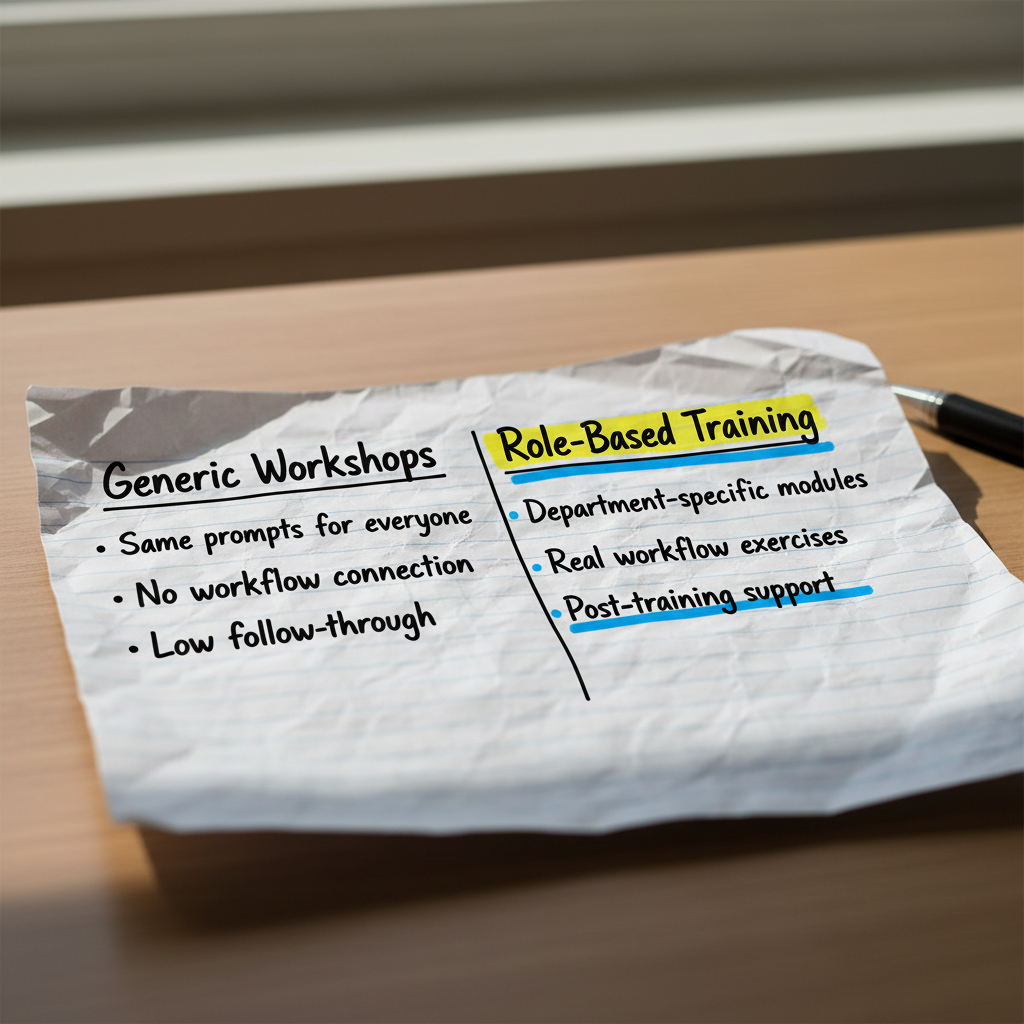
Role-based training connects AI learning to real departmental workflows—generic workshops rarely do.
Your AI training and consultancy partner should be able to scale delivery without diluting quality. Assess:
- Trainer bench strength — does the provider have multiple trainers with different specialisations (leadership, technical, sector-specific, governance)?
- Delivery formats — can they offer in-person workshops, virtual sessions, train-the-trainer models or hybrid approaches depending on your team's分布?
- Consistency across cohorts — how do they ensure that different teams in different locations receive the same quality of content?
- Programme structure — do they offer tiered programmes (awareness → fundamentals → advanced → custom) that allow you to scale progressively?
What to ask: "If we start with a pilot in one department and want to roll out across five business units within six months, what does that look like?"
Dimension 4: Business Alignment and Strategic Fit
AI training and consultancy should not operate in isolation. The best outcomes occur when the training aligns with your organisation's strategic priorities — whether that is improving customer experience, reducing operational costs, strengthening compliance or enabling new revenue streams.
Evaluate alignment by looking at:
- Pre-engagement discovery — does the provider invest time understanding your business context, current AI maturity, pain points and goals before proposing a programme?
- Leadership engagement — do they offer sessions for senior leaders to align on strategy, risk and governance before rolling out workforce training?
- Use-case identification — can they help your teams identify and prioritise AI use cases that are worth piloting, rather than offering a fixed curriculum?
- Governance and risk awareness — do they raise appropriate questions about data privacy, responsible use and human oversight, or only focus on productivity gains?
AIHQ's approach typically starts with leadership alignment sessions, followed by structured capability building, then optional implementation support where off-the-shelf tools are not enough. This sequenced model helps organisations move from awareness to measurable workflow improvement without skipping governance considerations.
Dimension 5: Responsible AI and Governance Readiness
As organisations scale AI usage, the questions shift from "what can AI do?" to "what should AI do?" and "how do we use it responsibly?"
A mature AI training and consultancy partner should be able to help you:
- Set guardrails for appropriate AI use, especially around confidential or sensitive information.
- Develop practical policies that translate into everyday employee behaviour, not just compliance documents.
- Train teams on responsible use — understanding accuracy limitations, avoiding over-reliance, maintaining human judgment in critical workflows.
- Address regulated environments — for organisations in banking, insurance, public sector or professional services, governance is not optional.
"Organisations should set clear guardrails for responsible AI use, especially around confidential or sensitive information." — AIHQ position on responsible adoption
What to ask: "How does your training or advisory work help organisations build responsible AI habits, not just technical skills?"
Putting the Framework Together: A Practical Checklist
Before engaging an AI training and consultancy partner, use this checklist as a quick reference:
| Evaluation Area | Key Question |
|---|---|
| Expertise Depth | Does the provider demonstrate multi-tool fluency and cross-sector experience? |
| Role-Based Capability | Are programmes designed for specific roles, or is it one-size-fits-all? |
| Scalability | Can delivery expand across teams, locations and maturity levels? |
| Business Alignment | Does the provider invest in understanding your context and priorities? |
| Governance Readiness | Is responsible use built into the programme, not added as an afterthought? |
A partner that scores well across these five dimensions is more likely to deliver sustained capability rather than a one-off training event.
Why Organisations Choose Structured AI Partnerships
Organisations that move beyond fragmented AI experimentation into structured adoption tend to share common characteristics: leadership alignment, role-based training, clear governance and a partner who understands that capability building is a journey, not a single purchase.
AIHQ has worked with corporate organisations, government agencies, professional institutions and regulated sectors across Malaysia and Singapore. The approach is built on moving organisations from interest through capability to practical usage and, where appropriate, custom solutions.
To explore how a structured AI training and consultancy partnership could support your organisation's adoption goals, the next step is a conversation about your current context and priorities.
FAQ
What is the difference between AI training and AI consultancy?
AI training focuses on building capability in your workforce — teaching people how to use AI tools, apply AI to workflows and adopt responsible usage habits. AI consultancy focuses on strategy, use-case identification, governance, implementation planning and, where needed, custom solutions. Many organisations benefit from both: consultancy to set direction, and training to build capability at scale.
How do I know if my organisation needs AI training, consultancy or both?
If your teams are already experimenting with AI but adoption is inconsistent, you may benefit from structured training. If you are unsure where AI creates value, or need governance frameworks before rolling out tools, consultancy or advisory work is a logical starting point. A good partner should help you diagnose this during an initial discovery conversation.
What should I look for in an AI consultancy firm for enterprises?
Look for demonstrated cross-sector experience, ability to engage both leadership and workforce audiences, a structured methodology that includes governance and responsible use, and a clear distinction between when to use off-the-shelf tools versus when custom solutions add value. Avoid firms that promise guaranteed ROI or treat AI adoption as a purely technical exercise.
Can AI training be customised for different roles within my organisation?
Yes. Role-based AI training connects learning to the specific workflows and tasks each team performs — for example, finance teams working with reconciliations and reporting, HR teams handling recruitment and policy documentation, or customer service teams managing enquiries. Generic one-size-fits-all workshops rarely drive sustained adoption across diverse departments.
How should I evaluate the ROI of an AI training and consultancy engagement?
ROI depends on your goals. Common measurement areas include: number of employees applying AI to daily workflows, reduction in time spent on repetitive tasks, quality improvements in reporting or documentation, and successful pilot projects that move from experimentation to implementation. A structured partner should help you define relevant metrics before the programme begins.