General
ChatGPT for Malaysian Enterprises: A Practical Guide to Adoption, Compliance & Local Language Support
· By AIHQ Team

ChatGPT has become one of the most accessible AI tools for Malaysian businesses. Teams use it for drafting emails, summarising reports, translating content, brainstorming ideas and analysing data.
But accessibility does not mean readiness. Many organisations adopt ChatGPT without understanding how it interacts with Malaysian data privacy laws, whether it handles Bahasa Malaysia reliably for customer-facing use, or how to move from casual experimentation to structured, role-based adoption.
This guide covers what Malaysian enterprises need to know about adopting ChatGPT — from compliance and language support to practical adoption pathways that create real workflow impact.
Why Malaysian Enterprises Are Turning to ChatGPT
ChatGPT reached over 100 million users within two months of launch, and enterprise adoption has grown rapidly since. For Malaysian organisations, the appeal is straightforward:
- Low barrier to entry — Anyone with an internet connection can start using it immediately.
- Broad applicability — Marketing, HR, finance, legal, customer service and operations teams all find useful workflows.
- Multilingual capability — ChatGPT supports Bahasa Malaysia, Mandarin, English and several other languages commonly used in Malaysian business.
- Cost-effective exploration — The free tier and affordable Plus subscription allow teams to explore before committing to larger investments.
However, the ease of entry creates a hidden problem. Teams adopt ChatGPT independently, without organisational guardrails, compliance awareness or role-specific guidance. This fragmented experimentation is where most enterprise adoption risks begin.
PDPA Compliance: What Malaysian Businesses Must Consider
Malaysia's Personal Data Protection Act (PDPA) 2010 regulates how businesses process personal data. When employees use ChatGPT with company information, several compliance questions arise.
Understanding ChatGPT's Data Handling
OpenAI provides different data handling policies depending on the product tier:
- ChatGPT Free and Plus — Conversations may be used for model training unless data-sharing is disabled in settings. Users should not input confidential or personal data on these tiers.
- ChatGPT Team — Conversations are not trained on OpenAI's models by default. Provides a higher level of data protection for business use.
- ChatGPT Enterprise — Enterprise-grade security with encrypted data, no training on business data, and SOC 2 compliance. Designed for organisations with strict data governance requirements.
Practical Steps for PDPA Compliance
Malaysian enterprises using ChatGPT should consider the following:
1. Classify what can and cannot be entered into ChatGPT. Personal data, client information, financial records, trade secrets and confidential strategy documents should not be entered into consumer-tier ChatGPT. Create a simple internal policy that defines safe versus restricted input types.
2. Use appropriate product tiers for sensitive work. ChatGPT Team or Enterprise tiers offer stronger data protection. For organisations handling significant personal data, the additional cost is often justified by reduced compliance risk.
3. Train teams on safe AI usage. Most employees do not know that their ChatGPT conversations could be reviewed or used for training. A short governance session helps teams understand what is appropriate to share and what must stay within internal systems.
Organisations should set clear guardrails for responsible AI use, especially around confidential or sensitive information. A practical AI governance workshop can help teams build these habits early.
4. Document your AI usage policy. Having a written policy that covers acceptable use, data classification, review processes and escalation paths strengthens your organisation's compliance position under PDPA.
Bahasa Malaysia Support: Can ChatGPT Handle Local Language Workflows?
For Malaysian enterprises serving local customers, Bahasa Malaysia support is often a requirement — not a nice-to-have. ChatGPT performs reasonably well in Bahasa Malaysia for most tasks, but there are important nuances.
Where ChatGPT Performs Well in Bahasa Malaysia
- General correspondence and email drafting — Standard business Bahasa Malaysia is handled well.
- Translation between English and Bahasa Malaysia — Useful for internal documents, customer communications and content adaptation.
- Basic customer enquiry responses — Frequently asked questions and standard replies work reliably.
- Content summarisation — Summarising Malay-language documents, reports or articles produces usable results.
Where Caution Is Needed
- Legal or regulatory language — Malay legal terminology and specific regulatory phrasing may not be accurately translated or interpreted.
- Cultural nuance and local expressions — ChatGPT may miss contextual cues, colloquialisms or industry-specific Malay usage.
- Highly technical or domain-specific Malay — Terms used in Malaysian government, finance or technical sectors may require human review.
Practical Approach for Bilingual Workflows
Most Malaysian enterprises operate in a bilingual or multilingual environment. An effective approach is:
- Use ChatGPT for drafting and translation — Save time on first drafts and routine translations.
- Always review local language output — Assign a native or fluent speaker to review customer-facing Bahasa Malaysia content.
- Build a glossary of approved terms — For regulated or branded communications, maintain a list of approved Malay terminology that ChatGPT should use.
For organisations needing reliable bilingual AI support across customer service, documentation or internal communications, a custom AI chatbot trained on your specific terminology and workflows may be more appropriate than a general-purpose tool alone.
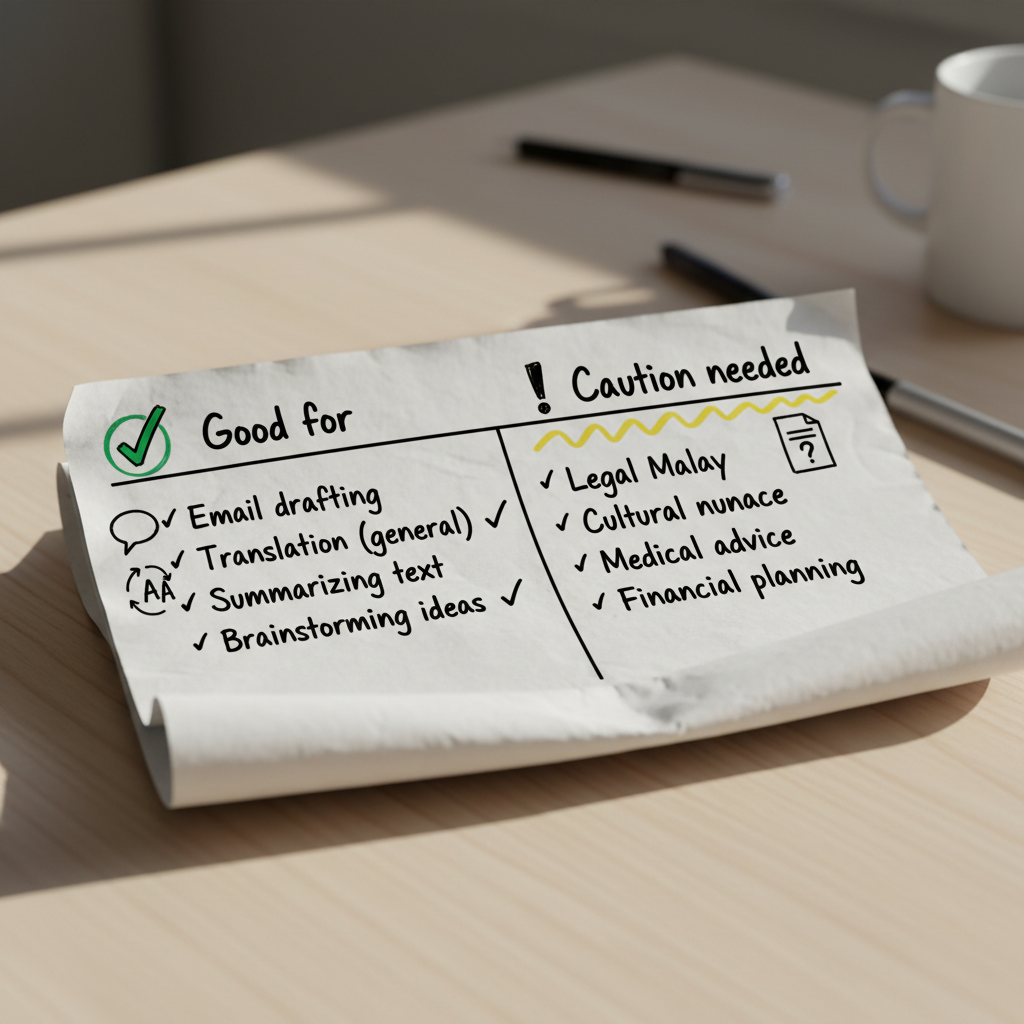
Bahasa Malaysia language workflows: where ChatGPT performs and where human review still matters.
Moving Beyond Basic Prompting: Structured Adoption for Enterprise
Many Malaysian organisations start their AI journey with a half-day ChatGPT workshop. While this builds awareness, it rarely creates sustained adoption. Employees try a few prompts, see interesting results, and return to their usual workflows within a week.
Prompting is useful, but sustainable adoption requires role-based capability, workflow thinking, governance and leadership alignment.
The Problem with One-Size-Fits-All ChatGPT Training
Generic ChatGPT training treats every employee the same. A marketing manager, a finance analyst, an HR executive and a customer service agent all use ChatGPT differently. Training them the same way guarantees most will not apply what they learn.
Role-based AI training creates stronger adoption because it connects the tool to actual daily work. When teams see how ChatGPT applies to their specific reports, emails, data analysis or customer interactions, they use it consistently.
A Structured Adoption Pathway for Malaysian Enterprises
Phase 1: Awareness and fundamentals Introduce ChatGPT and similar tools across the organisation. Cover basic usage, limitations, data safety and responsible use principles. This phase builds curiosity without creating risk.
Phase 2: Role-based capability building Design training by department or function. Show each team how ChatGPT applies to their specific workflows. Provide exercises that mirror their actual tasks.
Phase 3: Practical workflow integration Help teams move from experimenting to embedding ChatGPT into repeatable workflows. This might include standardised prompts, review processes and templates for common tasks.
Phase 4: Advanced usage and governance For teams ready to go further, explore custom GPTs, API integration and automation. Ensure governance keeps pace with usage.
Phase 5: Custom solutions where off-the-shelf is not enough Some workflows require more than ChatGPT alone. Internal copilots, custom AI chatbots or workflow automation may be appropriate when standard tools cannot deliver the precision, data security or integration needed.
Common ChatGPT Use Cases Across Malaysian Enterprise Departments
Marketing and Communications
- Drafting social media content in English and Bahasa Malaysia
- Generating blog post outlines and campaign ideas
- Adapting global content for local audience context
- Creating first drafts of press releases and newsletters
Human Resources
- Drafting job descriptions and offer letters
- Summarising employee feedback and survey responses
- Creating training materials and policy documents
- Responding to standard internal HR enquiries
Finance and Accounting
- Drafting report summaries and commentary
- Translating financial documents for bilingual reporting
- Assisting with variance analysis narratives
- Generating first-pass responses to audit queries
Customer Service
- Drafting standard replies to common customer enquiries
- Translating customer communications between English and Bahasa Malaysia
- Summarising customer feedback for service improvement
- Creating knowledge base articles from resolved tickets
Operations and Administration
- Drafting SOPs and process documentation
- Summarising meeting notes and action items
- Creating status reports and project updates
- Responding to routine internal enquiries
When ChatGPT Is Not Enough
ChatGPT is a powerful general-purpose tool, but it has limitations in enterprise contexts:
- Data privacy — Consumer-tier ChatGPT does not guarantee data isolation.
- Consistency — Responses vary between sessions, making it unreliable for standardised customer-facing content.
- Integration — ChatGPT does not connect directly to your internal databases, CRM, ERP or knowledge base.
- Customisation — You cannot train ChatGPT on your specific policies, products or terminology without using custom GPTs or API-based solutions.
Off-the-shelf tools are useful, but some workflows require custom AI solutions, automation or structured implementation. When your organisation needs reliable, governed, integrated AI support, a custom AI chatbot or internal copilot may be the right path.
Building an Enterprise AI Strategy Around ChatGPT
Adopting ChatGPT is not just a tool decision — it is a capability decision. Organisations that treat it as a simple productivity tool miss the opportunity to build structured AI capability across their workforce.
Leadership alignment matters before large-scale rollout. When leadership understands the risks, opportunities and adoption pathway, they can support teams more effectively and avoid the fragmentation that slows real progress.
For organisations ready to move beyond casual ChatGPT use, structured AI training programmes that align with roles, workflows and governance needs create stronger and safer adoption.
How AIHQ Can Help
AIHQ has trained and engaged over 9,000 professionals in AI and Generative AI, working across corporate organisations, government agencies, professional institutions and regulated environments in Malaysia and Singapore.
Our approach moves organisations from AI awareness to structured capability, practical adoption and real workflow impact — without the hype.
Whether your organisation needs role-based ChatGPT training, leadership alignment on AI strategy, governance workshops for responsible use, or custom AI solutions where off-the-shelf tools are not enough, AIHQ can help structure a pathway that fits your context.
FAQ
Is it safe for Malaysian employees to use ChatGPT with company data?
It depends on the data type and the ChatGPT tier. Consumer-tier ChatGPT Free and Plus may use conversation data for model training. For confidential or personal data, organisations should use ChatGPT Team or Enterprise tiers, which offer stronger data protection. AIHQ recommends classifying data types and creating clear internal policies for what can and cannot be entered into ChatGPT.
Can ChatGPT handle Bahasa Malaysia well for customer-facing content?
ChatGPT performs reasonably well for general Bahasa Malaysia tasks such as email drafting, translation and basic customer enquiries. However, legal terminology, cultural nuance and domain-specific Malay may require human review. For consistent, branded Bahasa Malaysia content, organisations should implement a review workflow or consider a custom solution trained on approved terminology.
What is the difference between ChatGPT Free, Plus, Team and Enterprise?
ChatGPT Free and Plus offer general access but may use conversation data for training. ChatGPT Team provides stronger data privacy with no training on business data. ChatGPT Enterprise includes enterprise-grade security, SOC 2 compliance, encrypted data and administrative controls. Malaysian enterprises handling personal data should consider Team or Enterprise tiers for compliance.
Does ChatGPT comply with Malaysia's Personal Data Protection Act (PDPA)?
Compliance depends on how ChatGPT is used. Organisations must ensure personal data is not entered into consumer-tier ChatGPT without appropriate safeguards. Using enterprise-grade tiers, classifying data inputs, training employees on safe usage, and documenting an AI usage policy all support PDPA compliance. AIHQ recommends a governance session to address these requirements.
How can Malaysian enterprises move beyond basic ChatGPT prompting?
Sustainable adoption requires role-based training, workflow integration, governance and leadership alignment — not just prompt sessions. AIHQ recommends a structured pathway: awareness and fundamentals, role-based capability building, practical workflow integration, advanced usage with governance, and custom solutions where off-the-shelf tools are insufficient.
When should a Malaysian enterprise consider a custom AI solution instead of ChatGPT?
When the organisation needs data privacy guarantees, consistent responses integrated with internal systems, customisation for specific terminology or policies, or reliable handling of governed workflows. Off-the-shelf ChatGPT is excellent for general tasks, but custom AI chatbots, internal copilots or automation solutions may be more appropriate for critical or regulated workflows.