General
ChatGPT Malaysia Adoption: A Practical Guide for Malaysian Businesses
· By AIHQ Team

Many Malaysian businesses have already started using ChatGPT. Individual team members experiment with it for drafting emails, summarising reports or brainstorming ideas. But there is a difference between casual tool use and structured organisational adoption.
When ChatGPT usage stays at the individual level, organisations face real risks: inconsistent output, unclear data boundaries, uneven capability across teams, and missed opportunities for workflow improvement. The question is not whether your teams are using ChatGPT — it is whether they are using it well, safely and consistently.
This guide walks through a practical path for ChatGPT Malaysia adoption — from selecting the right use cases to building team capability and setting organisational guardrails.
Why Structured ChatGPT Adoption Matters for Malaysian Organisations
ChatGPT and similar Generative AI tools are widely available, but availability does not equal readiness. Malaysian organisations face several common challenges when moving from ad-hoc usage to structured adoption:
- Inconsistent quality — Different team members use ChatGPT in very different ways, producing uneven results.
- Data safety gaps — Employees may paste confidential information into public tools without clear guidelines.
- Skills imbalance — Some teams adopt quickly while others remain unsure how to start.
- No workflow integration — ChatGPT output stays in isolated conversations rather than connecting to actual business processes.
A structured approach to adoption helps organisations move beyond these gaps. Instead of relying on individual experimentation, teams can use ChatGPT in ways that are practical, safe and aligned with business priorities.
Step 1: Identify Practical Use Cases for Your Teams
The most effective ChatGPT adoption starts with use cases, not tools. Before rolling out training, ask each department what repetitive or time-consuming tasks could benefit from AI support.
Common high-value use cases in Malaysian businesses include:
- Customer service — Drafting responses to common enquiries, summarising conversation histories, and suggesting escalation paths.
- Marketing and communications — Generating social media content, editing press releases, localising content for Bahasa Malaysia, and brainstorming campaign angles.
- HR and administration — Drafting job descriptions, summarising policy documents, preparing offer letters, and answering frequently asked employee questions.
- Finance and reporting — Drafting commentary on financial summaries, preparing report narratives, and standardising recurring documentation.
- Operations and compliance — Summarising SOP documents, preparing audit trail notes, and drafting procedural updates.
The goal is not to automate entire workflows. It is to identify specific, repeatable tasks where ChatGPT can reduce manual effort while keeping human review and judgment in place.
Step 2: Build Team Capability Through Role-Based Training
Generic ChatGPT workshops that teach basic prompting often fail to create sustained adoption. Teams need training that connects directly to their daily work.
Role-based AI training is more effective because it helps participants see exactly how ChatGPT applies to their specific tasks. For example:
- A marketing team learns how to use ChatGPT for content briefs, audience research and multilingual localisation.
- An HR team practises drafting policy summaries, job descriptions and internal communications.
- A finance team explores how ChatGPT can support report narratives and data interpretation notes, while understanding where human oversight is essential.
This approach moves teams beyond surface-level prompting into practical, confident usage. When employees understand how ChatGPT fits into their actual workflows, adoption becomes self-sustaining.
AIHQ designs role-based AI training programmes that help Malaysian organisations build structured capability across departments. To learn more, explore AIHQ's AI training programmes or contact AIHQ to discuss a roadmap for your teams.
Step 3: Set Organisational Guardrails for Safe Use
One of the biggest concerns Malaysian businesses face with ChatGPT adoption is data safety. Without clear guidelines, employees may share sensitive company information, client data or confidential documents with public AI tools.
Practical guardrails every organisation should consider:
- Publish a simple AI use policy — Clarify what types of data can and cannot be entered into ChatGPT. For example, internal policies, public information and non-confidential drafts may be acceptable, while client personal data, financial records and trade secrets require stronger controls.
- Encourage human review — ChatGPT output should always be reviewed before use, especially for customer-facing communications, compliance documents and data-sensitive work.
- Use enterprise versions where appropriate — ChatGPT Enterprise, Microsoft Copilot with data protection, or custom internal solutions offer stronger data privacy controls than public consumer tools.
- Provide practical examples — Instead of only stating what not to do, show teams examples of safe and unsafe usage so the guidelines are easy to follow.
Organisations scaling AI usage can also benefit from responsible AI training and governance workshops to help teams understand safe adoption practices.
Step 4: Move From Experimentation to Workflow Integration
Once teams are comfortable using ChatGPT for individual tasks, the next step is integrating AI into repeatable workflows. This is where adoption moves from occasional use to sustained productivity improvement.
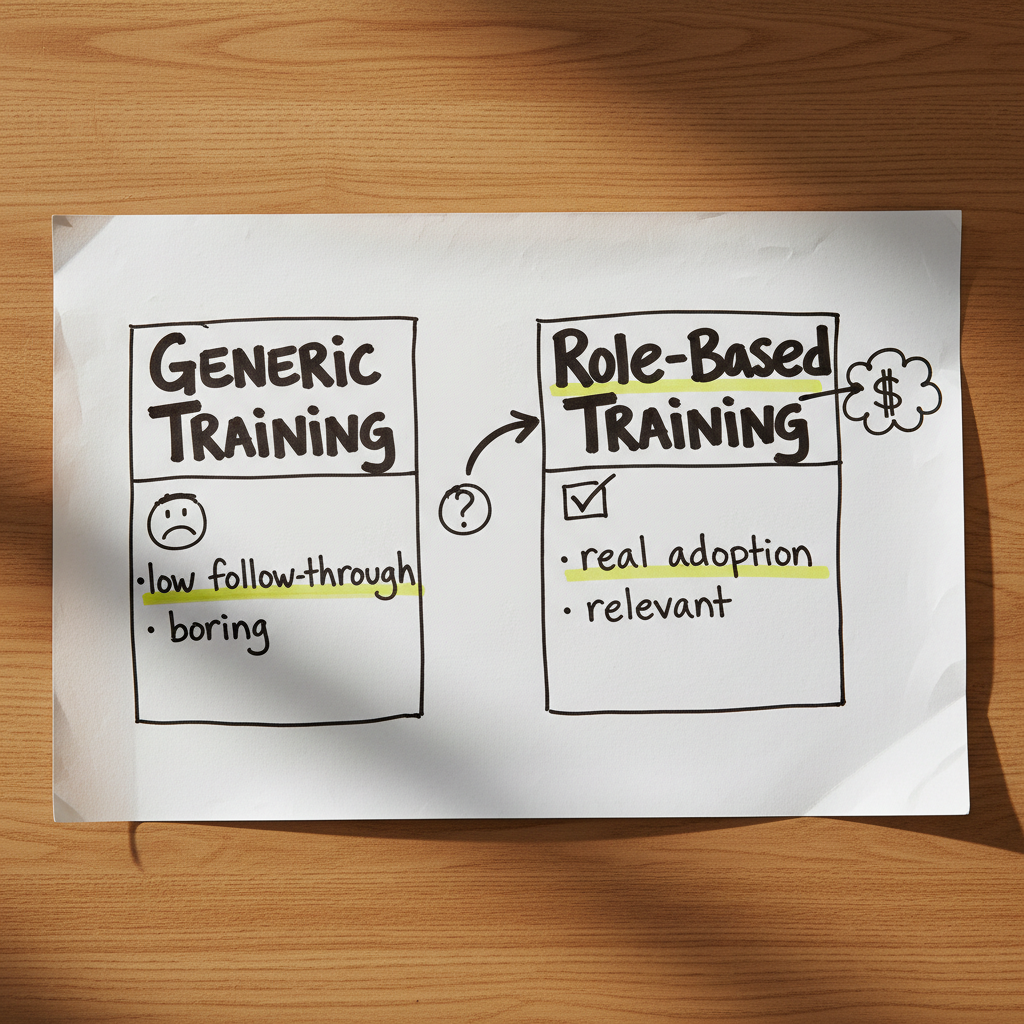
Role-based training connects AI skills directly to daily work, creating sustained adoption.
Examples of workflow integration:
- A customer service team creates standardised ChatGPT prompts for handling common enquiry types, with templates reviewed and approved by senior staff.
- A communications team builds a workflow where ChatGPT generates first drafts of Bahasa Malaysia content, reviewed by a native speaker before publication.
- An operations team uses ChatGPT to summarise meeting notes and action items consistently across departments.
The key is repetition and structure. When ChatGPT usage becomes part of a documented workflow — rather than a random habit — organisations can start tracking where it adds value and where it needs improvement.
Step 5: Review, Refine and Scale
Adoption is not a one-time project. Organisations that adopt ChatGPT well treat it as an ongoing capability-building effort.
Review questions to ask after three to six months:
- Which use cases have generated the most consistent value?
- Which teams are adopting well, and which need additional support?
- Are there new tasks or workflows that could benefit from AI support?
- Are the current guardrails still appropriate, or do they need updating?
- Have any data or accuracy issues emerged that need attention?
Regular reviews help organisations refine their approach, identify advanced use cases and decide when off-the-shelf tools are enough — or when custom AI solutions may be needed for specific workflows.
Common ChatGPT Adoption Challenges in Malaysia
Challenge 1: Teams treat ChatGPT as a search engine
Many users expect ChatGPT to provide accurate factual answers like Google. This leads to over-reliance and occasional errors. The solution is training that frames ChatGPT as a drafting and brainstorming tool, not a source of truth.
Challenge 2: Bahasa Malaysia support feels inconsistent
ChatGPT handles Bahasa Malaysia reasonably well for common tasks, but technical, legal or industry-specific terms may require review. Teams should treat ChatGPT's Bahasa Malaysia output as a first draft that needs a native speaker's review.
Challenge 3: Adoption is driven by individuals, not leadership
When ChatGPT adoption is left to individual initiative, it creates inconsistency. Leadership alignment — even a simple endorsement and set of guidelines — helps normalise adoption across teams.
Challenge 4: No clear measurement of impact
Organisations often adopt ChatGPT without tracking whether it saves time or improves quality. Simple tracking, such as before-and-after time estimates for common tasks, can help teams understand real value.
When Off-the-Shelf ChatGPT Is Not Enough
ChatGPT is a powerful general-purpose tool, but some workflows require more than an off-the-shelf AI assistant. Organisations may need custom AI solutions when:
- Workflows involve complex internal data that ChatGPT cannot access securely.
- Teams need an internal copilot trained on company SOPs, policies or knowledge bases.
- Customer-facing interactions require a branded, controlled chatbot with escalation logic.
- Automation needs to connect multiple systems, not just respond to text prompts.
In these situations, structured implementation support can help organisations move beyond general-purpose tools into tailored workflow improvement.
Final Thoughts
ChatGPT Malaysia adoption does not have to be complicated. By starting with practical use cases, building role-based capability, setting clear guardrails and reviewing progress regularly, organisations can move from fragmented experimentation to structured, safe and useful adoption.
The organisations that benefit most from ChatGPT are not the ones that use it for everything. They are the ones that use it deliberately — for the right tasks, with the right training, and with appropriate oversight.
If your organisation is ready to move beyond basic ChatGPT experimentation into structured adoption, AIHQ can help. From role-based AI training to leadership alignment sessions and custom AI solutions, AIHQ supports Malaysian organisations at every stage of the adoption journey.
FAQ
What is the first step for ChatGPT adoption in a Malaysian business?
The first step is identifying practical use cases within each department. Look for repetitive, time-consuming tasks where ChatGPT can support drafting, summarisation or brainstorming — such as customer service responses, content drafts, policy summaries or report narratives. Start with low-risk use cases and build confidence before expanding.
Is ChatGPT safe for confidential company data?
It depends on the tool version and settings. Public consumer ChatGPT does not guarantee data privacy, so organisations should avoid entering confidential information into it. Enterprise versions of ChatGPT and Microsoft Copilot offer stronger data protection controls. Every organisation should set clear guidelines about what data can and cannot be shared with AI tools.
Can ChatGPT handle Bahasa Malaysia well?
ChatGPT handles Bahasa Malaysia reasonably well for common and general content. However, technical, legal or industry-specific terms may require human review. It is best treated as a first draft tool, with a native speaker reviewing output before publication or use.
How is role-based AI training different from generic ChatGPT workshops?
Generic workshops teach basic prompting to everyone the same way. Role-based training connects AI usage to specific departmental workflows — for example, marketing teams practise content creation, HR teams work on policy summaries, and finance teams explore reporting support. This creates higher relevance and stronger adoption because participants see how AI applies directly to their work.
When should a business consider a custom AI solution instead of ChatGPT?
When workflows involve internal data that ChatGPT cannot access securely, when teams need an internal copilot trained on company SOPs or policies, or when customer-facing interactions require a branded chatbot with controlled escalation logic. Off-the-shelf tools work well for general tasks, but structured workflows often benefit from custom implementation.
How long does it take to see results from ChatGPT adoption?
Teams often see time savings on specific tasks within weeks of structured training. However, meaningful organisation-wide impact — such as consistent workflow integration and measurable productivity improvement — typically develops over three to six months with regular review and refinement.