General
The Complete Guide to AI Agents Training Courses: Online & in Malaysia
· By AIHQ Team

AI agents are no longer just a technical curiosity. They are becoming part of how organisations automate workflows, handle customer enquiries, support internal knowledge systems and improve decision-making processes.
But building, managing and deploying AI agents responsibly requires structured skills — not just familiarity with ChatGPT. That is where a well-designed AI agents training course makes the difference.
This guide covers what AI agents training includes, how online courses compare to local Malaysia-based programmes, what to look for at different skill levels, and how to choose the right path for your organisation or career.
What Are AI Agents and Why Do They Need Training?
An AI agent is a system that can perform tasks autonomously — retrieving information, making decisions, executing workflows, escalating issues or triggering actions — within defined boundaries. Unlike a chat interface that waits for prompts, an agent can act on instructions across multiple steps.
Examples include:
- A customer service agent that checks order status, updates records and escalates without human input each time
- An internal copilot that searches SOPs, policies and knowledge bases to answer employee queries
- A coding agent that writes, tests and refactors code based on a developer's brief
Because agents operate with more autonomy than standard chatbots, they require careful design, clear guardrails, responsible use practices and ongoing oversight. Training helps teams understand both the technical and governance dimensions.
What Does an AI Agents Training Course Cover?
A good AI agents training course typically spans several competency areas. Here is what to expect across beginner, intermediate and advanced levels.
Beginner Level: Foundations
- What AI agents are and how they differ from chatbots and copilots
- How agents use large language models (LLMs), tools and memory
- Simple single-agent workflows and use-case identification
- Basic prompt engineering for agent instructions
- Responsible use principles: oversight, accuracy and data boundaries
Intermediate Level: Building and Deploying Agents
- Multi-step agent workflows and task decomposition
- Connecting agents to tools, APIs and internal data sources
- Error handling, fallback logic and escalation design
- Role-based agent design for different functions (customer service, HR, operations)
- Testing, monitoring and improving agent performance
Advanced Level: Multi-Agent Orchestration
- Designing systems where multiple agents coordinate tasks
- Agent communication patterns and delegation logic
- Governance across agent networks: permissions, audit trails and human-in-the-loop
- Custom agent frameworks and integration with enterprise systems
- Scaling agents responsibly across departments
Online AI Agents Training Courses: Global Options
Several global platforms offer structured AI agents training courses. These are useful for individual learners, developers and teams who prefer self-paced learning.
Coursera and edX
Coursera and edX host university-backed specialisations covering AI agents, LLM application development and multi-agent systems. These tend to be academically rigorous and suitable for technical audiences.
Best for: Developers, data scientists and technical leads who want theory plus hands-on assignments.
DeepLearning.AI
Andrew Ng's platform offers short, practical courses on agentic AI design, building agents with frameworks like LangGraph and AutoGen, and deploying agents for real use cases.
Best for: Practitioners who want applied skills quickly without long academic programmes.
Udemy and LinkedIn Learning
These platforms offer accessible, low-cost introductions to AI agents. Course quality varies, so look for recent content from instructors with practical implementation experience.
Best for: Beginners exploring agentic AI concepts and simple hands-on exercises.
Vendor-Specific Certifications
Major AI platforms offer certifications relevant to AI agents:
- OpenAI — Developer certifications covering assistants API and function calling
- Microsoft — Azure AI and Copilot certifications covering agent-like workflows
- Google Cloud — Vertex AI and Agent Builder certifications
- Anthropic — Claude API and tool use patterns
Best for: Teams committed to a specific platform or ecosystem.
AI Agents Training Courses in Malaysia
For organisations in Malaysia, locally available AI agents training courses offer several advantages: context-relevant use cases, alignment with local governance needs, in-person or live facilitation, and HRDC-claimable options.
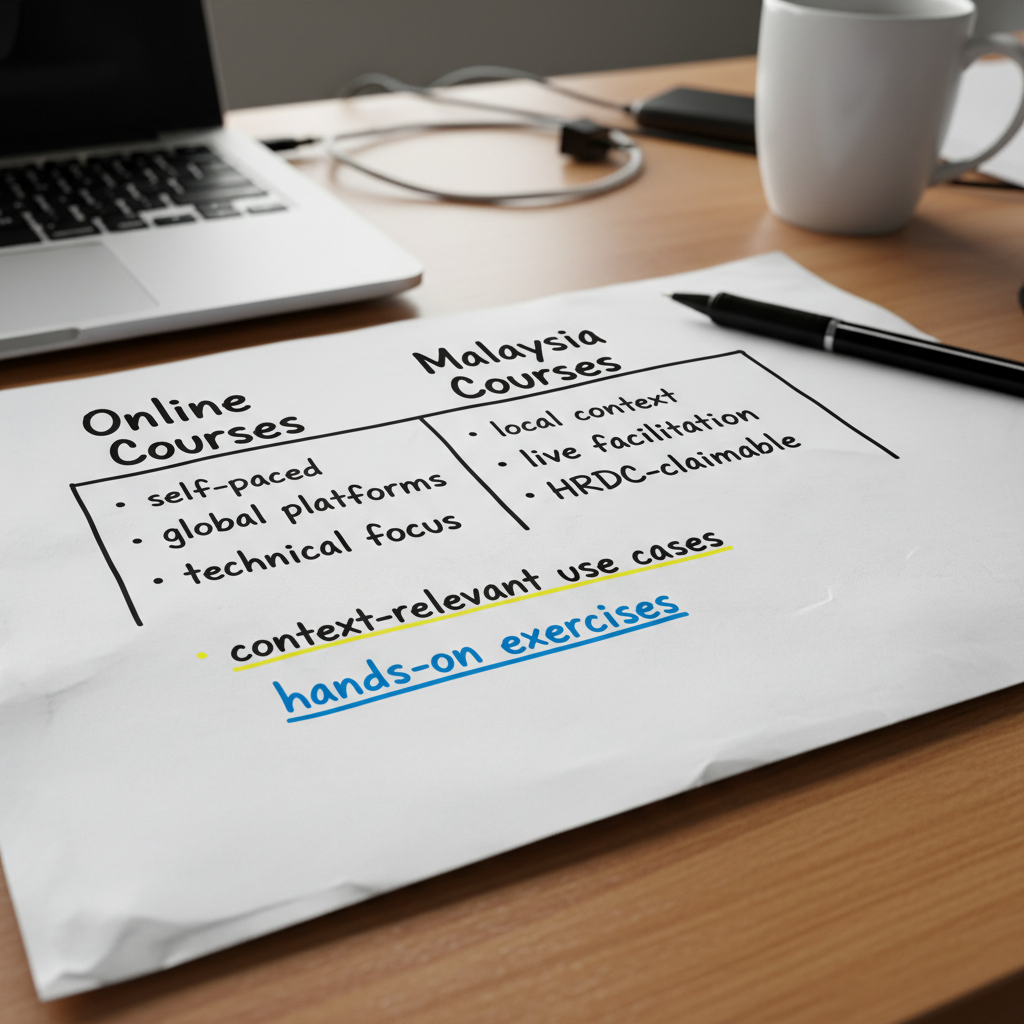
Comparing online AI agents courses with locally available Malaysia-based programmes.
What to Look for in a Malaysia-Based Course
- Practical, role-based content — The course should connect agentic AI skills to real organisational workflows, not just theory.
- Responsible AI and governance coverage — Malaysian organisations need to understand data boundaries, human oversight and safe deployment within local regulatory expectations.
- Hands-on exercises — Building a simple agent or workflow is more valuable than watching slides.
- Facilitator experience — Look for trainers who have implemented AI solutions, not just taught tool usage.
- HRDC claimability — For organisations using HRD Corp levies, check whether the programme can be structured as HRDC claimable, subject to eligibility and approval.
AIHQ's Approach to AI Agents Training
AIHQ offers structured AI agents training as part of its broader technical and role-based capability-building programmes. These sessions cover:
- Understanding when an AI agent is the right solution versus a simpler chatbot or copilot
- Designing workflows that agents can execute safely with appropriate guardrails
- Building and testing agents using accessible frameworks and tools
- Governance considerations including permissions, audit trails and human review
- Practical exercises tied to real organisational workflows
AIHQ has trained over 9,000 professionals across corporate, public sector and regulated environments. The training is designed to be practical, role-appropriate and grounded in responsible use.
For teams considering AI agents, AIHQ can also help explore whether a custom AI solution — such as an internal copilot or workflow automation — is more appropriate than deploying off-the-shelf agents.
How to Choose the Right AI Agents Training Course
Here is a practical framework for evaluating courses.
| Factor | What to Consider |
|---|---|
| Learner level | Are participants new to AI, experienced with LLMs, or building production systems? Choose a course that matches their starting point. |
| Practical focus | Does the course include hands-on exercises building actual agents or workflows, or is it purely slide-based? |
| Governance content | Does the course address human oversight, data boundaries and responsible agent design, or only technical implementation? |
| Context relevance | For Malaysian teams, does the course use local workflows, regulatory awareness and practical deployment scenarios? |
| Certification value | Does the certification carry weight with your organisation or clients? Vendor certs may be more useful for platform-specific roles. |
| Delivery format | Self-paced online works for individual learners. Live or in-person is better for team alignment and organisation-wide adoption. |
Common Questions About AI Agents Training
Do I need coding experience for AI agents training?
Not always. Beginner courses introduce agentic concepts without requiring code. However, intermediate and advanced courses typically involve scripting, API usage or framework configuration. Some courses offer no-code or low-code paths for business users.
How long does it take to become proficient with AI agents?
This depends on your starting point. Beginners can grasp foundational concepts in a few days of focused training. Building production-ready agents with proper governance typically requires several weeks of practice, iteration and review.
Are AI agents safe to deploy without governance training?
AIHQ recommends that teams complete responsible AI and governance training before deploying agents with autonomous capabilities. Agents that access internal data, trigger actions or interact with customers need clear guardrails, escalation paths and human oversight.
Can AI agents replace existing workflows entirely?
In most cases, agents augment or automate parts of a workflow rather than replacing it entirely. Practical adoption typically starts with a well-scoped pilot — automating a specific task, handling a defined enquiry type or supporting a single SOP — before expanding.
Building Agentic AI Capability in Your Organisation
AI agents training is most effective when it connects to a broader organisational capability plan. Here is a suggested pathway:
- Start with AI literacy — Ensure teams understand what agents can and cannot do responsibly.
- Identify use cases — Work through a structured use-case discovery process to find where agents add value.
- Train by role — Developers need technical agent-building skills. Business teams need agent oversight and workflow design skills.
- Pilot with guardrails — Deploy one agent workflow, monitor outcomes, iterate on design and governance.
- Scale thoughtfully — Expand to additional workflows only after the first pilot shows clear, measurable handling.
AIHQ can support each stage of this journey through role-based AI training, leadership alignment sessions, and custom AI solutions where off-the-shelf tools are not enough.
Summary
AI agents training is becoming an essential capability for organisations planning to move beyond basic chatbot usage into structured, governed automation. Whether you choose an online certification or a Malaysia-based programme, the key is finding training that combines practical skills, responsible design and context-relevant use cases.
Start by assessing your team's current skill level, identifying a well-scoped use case, and choosing a course that builds both technical confidence and governance awareness.
FAQ
What is the difference between an AI agent and a chatbot?
A chatbot typically responds to user prompts in a turn-by-turn conversation. An AI agent can operate more autonomously — it can retrieve information, execute multi-step workflows, make decisions within defined boundaries and trigger actions without waiting for human input at every step. Agents are better suited for task automation, while chatbots are better for guided conversations.
Are there AI agents training courses available in Malaysia?
Yes. Several global platforms offer online courses, and Malaysia-based providers like AIHQ offer structured AI agents training for organisations. Local programmes have the advantage of context-relevant use cases, alignment with local governance expectations, live facilitation, and the potential to be HRDC claimable, subject to eligibility and approval.
Do I need a technical background to take an AI agents course?
Beginner-level AI agents courses are accessible to non-technical learners. However, intermediate and advanced courses typically require familiarity with APIs, scripting or framework configuration. Some providers offer no-code paths for business users alongside technical tracks for developers.
How can I ensure my team uses AI agents safely?
AIHQ recommends completing responsible AI and governance training before deploying agents with autonomous capabilities. Agents that access internal data, make decisions or interact with customers need clear guardrails, human oversight, escalation paths and regular performance reviews.
What should I look for in an AI agents training provider?
Look for practical, hands-on content rather than theory-only sessions. The course should cover responsible agent design, governance and use-case identification — not just tool usage. For organisational training, facilitator experience with real AI implementations and role-based content increases relevance and adoption.
Can AI agents training be structured as HRDC claimable in Malaysia?
AIHQ programmes can be structured to be HRDC claimable, subject to client eligibility, grant approval and HRD Corp submission requirements. Always confirm eligibility with your HRD Corp account manager and the training provider before enrolment.