General
Top AI Automation Courses in Malaysia: A Step-by-Step Guide for Professionals
· By AIHQ Team

The search for an "AI automation course Malaysia" often leads to a crowded list of options — from short online certificates to intensive bootcamps and enterprise training programmes. Many promise quick results, but few deliver lasting workplace capability.
This guide is designed for Malaysian professionals who want more than just a certificate. It covers how to evaluate AI automation courses, what distinguishes genuine skill-building from generic overviews, and how to choose a path that builds real career and organisational value.
Why AI Automation Skills Matter for Malaysian Professionals
AI automation is no longer a niche technical skill. Across industries in Malaysia — from finance and retail to logistics, media and public service — organisations are looking for professionals who can identify repetitive workflows, understand where AI tools add value, and implement practical automation safely.
Roles that involve reporting, documentation, data processing, customer enquiries, approvals, scheduling and compliance workflows are already being reshaped by AI. Professionals who build capability in these areas are better positioned to:
- Improve productivity in their current role
- Contribute to departmental process improvement
- Take on AI-related responsibilities as organisations scale adoption
- Stay competitive as automation becomes embedded in daily operations
AIHQ has trained and engaged over 9,000 professionals across corporate organisations, government agencies and regulated sectors in Malaysia. The pattern is clear: the professionals who benefit most are those who move beyond watching tool demos and invest in structured, practical capability building.
What to Look for in an AI Automation Course
Not all AI automation courses are created equal. Many focus on tool features without addressing how automation fits into real workflows, governance or team collaboration.
Here are the key factors to evaluate when choosing a course:
1. Practical, Workflow-Based Content
The best courses do not just demonstrate tools. They help you apply AI automation to actual tasks you handle — whether that is generating reports, summarising documents, processing data, responding to enquiries or managing approvals.
Look for courses that include:
- Hands-on exercises using real or realistic business scenarios
- Templates and workflows you can adapt after the session
- Guidance on reviewing and improving AI-generated output
2. Role Relevance
A marketing automation workflow is very different from a finance reconciliation workflow. A one-size-fits-all course may provide useful basics, but courses that align with your specific role or function deliver faster, more relevant value.
3. Responsible Use and Governance
AI automation introduces risks around data privacy, accuracy and accountability. A quality course should address:
- What data is safe to use with which tools
- How to review and verify AI outputs
- When human judgment and escalation are necessary
- Organisational guardrails for responsible use
4. Trainer and Provider Credibility
Who is delivering the training matters. Look for providers with:
- Proven experience across multiple sectors
- Track record with corporate, public sector and regulated environments
- Trainers who combine business understanding with technical capability
AIHQ's trainers include specialists in leadership alignment, applied AI, responsible AI and data analysis — each bringing practical experience from working with organisations across Malaysia.
Types of AI Automation Courses Available in Malaysia
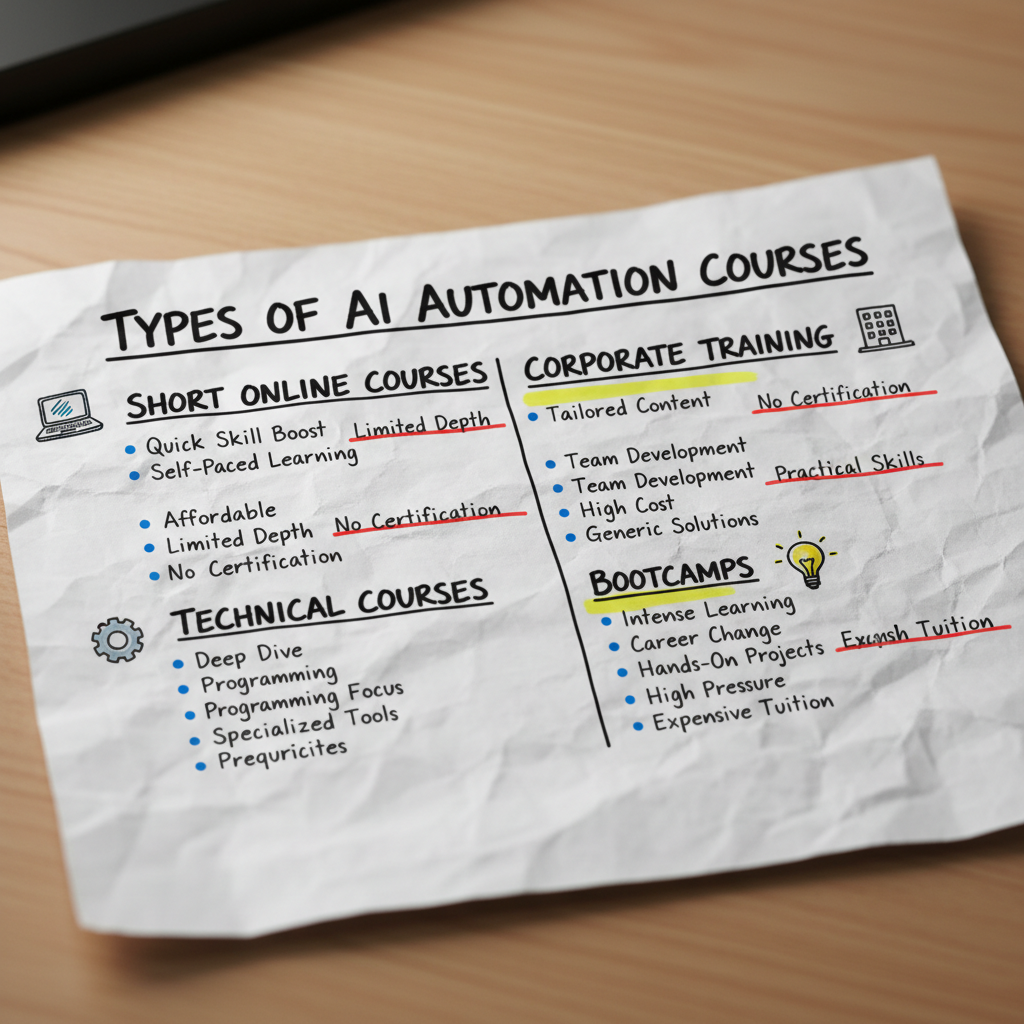
Comparing course types — from online certificates to enterprise training and bootcamps.
The Malaysian market offers several types of AI automation training programmes. Understanding the differences helps you choose the right fit.
Short Online Courses and Certificates
Platforms like Coursera, Udemy and LinkedIn Learning offer self-paced introductions to AI automation. These are useful for foundational awareness and exploring concepts at your own pace.
Best for: Individual learners exploring AI basics on a flexible schedule. Limitations: Generic content, no role-specific guidance, limited feedback or accountability.
Corporate and Enterprise AI Training Programmes
Structured corporate programmes — like those offered by AIHQ — are designed for teams and organisations. They focus on practical adoption, role-based workflows and responsible use. Programmes can be tailored to specific departments such as HR, finance, operations or customer service.
Best for: Professionals whose organisations are investing in structured AI upskilling. Also suitable for teams that need consistent capability building across departments.
Limitations: Requires organisational commitment and coordination.
Technical AI Automation Courses
For professionals in IT, data or engineering roles, technical courses cover AI-assisted coding, API integration, agentic workflows and automation architecture.
Best for: Developers, IT teams and technical professionals building or maintaining AI automation systems.
Limitations: Assumes prior technical knowledge. Less relevant for non-technical roles.
AI Innovation Bootcamps and Workshops
Bootcamps and structured workshops focus on identifying and prioritising automation opportunities within a team or organisation. These are less about tool skills and more about strategic workflow improvement.
Best for: Teams and departments looking to audit current workflows and plan automation initiatives.
Limitations: Shorter format. Best combined with ongoing capability building.
How to Choose the Right AI Automation Course for Your Needs
Follow these steps to evaluate and select an AI automation course that matches your goals.
Step 1: Define Your Starting Point
Ask yourself:
- Are you completely new to AI automation?
- Do you already use tools like ChatGPT or Microsoft Copilot in your daily work?
- Are you looking for individual skill-building or does your team need a consistent approach?
Your starting point determines whether a fundamentals course, an intermediate workflow workshop or a technical programme is the right fit.
Step 2: Identify Your Workflow Context
List the tasks you handle regularly that involve:
- Repetitive writing, formatting or data entry
- Document summarisation or report generation
- Data extraction, comparison or validation
- Customer or internal enquiry handling
- Approval or compliance workflows
Courses that address your specific workflow types will deliver more relevant and transferable skills.
Step 3: Check for Role-Based Content
Ask the provider whether their course content is tailored to your role or if it uses generic examples. Role-based training — where finance professionals learn automation relevant to finance workflows, and HR professionals learn HR-relevant automation — creates stronger adoption than generic workshops.
Step 4: Verify Credibility and Experience
Review the provider's track record. How many professionals have they trained? Which sectors have they worked with? Who are their trainers and what is their background?
AIHQ has delivered programmes for organisations including ACCA, Media Prima Group, Silverlake Group, Prudential BSN Takaful, Selangor State Government, SME Corp Malaysia and others. AIHQ is also a registered HRD Corp training provider, meaning programmes can be structured to be HRDC claimable, subject to client eligibility, grant approval and HRD Corp submission requirements.
Step 5: Evaluate Post-Training Support
The best courses do not end when the session finishes. Look for programmes that offer:
- Templates, guides or workflow references to use afterwards
- Access to updated materials as tools evolve
- Options for follow-up sessions or advanced workshops
Common Pitfalls to Avoid
As you evaluate AI automation courses in Malaysia, watch out for these common issues:
Pitfall 1: Tool demonstrations without workflow context. Knowing how to use a tool is different from knowing how to apply it effectively to real work.
Pitfall 2: Overpromising results. Be cautious of courses that claim guaranteed productivity gains or instant transformation. Outcomes depend on adoption, practice and organisational factors.
Pitfall 3: Ignoring data safety and governance. AI automation involves company data. Courses that do not address responsible use, data privacy and appropriate guardrails are incomplete.
Pitfall 4: One-size-fits-all content. If the course content is the same for every participant regardless of role, it is unlikely to build deep, practical capability.
A Practical Path Forward for Malaysian Professionals
Whether you are exploring AI automation for your own career growth or planning capability building for your team, the key is to start with structured, practical learning that connects directly to real workflows.
Generous tool access and short video tutorials can create awareness, but sustainable capability comes from programmes that combine hands-on application, role-specific content, responsible use principles and ongoing support.
AIHQ's approach is designed around this principle: move professionals and teams from AI awareness into practical usage, structured capability and real workflow improvement.
Frequently Asked Questions
What is the difference between an AI automation course and a general AI awareness course?
An AI awareness course typically introduces concepts, tools and terminology at a high level. An AI automation course goes deeper — helping participants apply AI to specific tasks, understand workflow integration and build repeatable processes.
Can AI automation courses in Malaysia be claimed under HRDC?
AIHQ is a registered HRD Corp training provider. Programmes can be structured to be HRDC claimable, subject to client eligibility, grant approval and HRD Corp submission requirements. Always check with the provider and your organisation's HR team.
Do I need technical coding skills to take an AI automation course?
Not necessarily. Many AI automation courses are designed for non-technical professionals and focus on using off-the-shelf tools like ChatGPT, Microsoft Copilot or low-code automation platforms. Technical courses are available separately for developers and IT teams.
How long does it take to see results from AI automation training?
Practical outcomes depend on the learner's role, the relevance of the training content and how consistently the skills are applied. Well-designed role-based training often shows faster adoption because participants can immediately apply what they learn to their existing workflows.
Which industries in Malaysia benefit most from AI automation training?
While all industries can benefit, sectors with repetitive documentation, reporting, data processing and enquiry workflows — such as finance, banking, insurance, logistics, media, retail, government and professional services — tend to see the most immediate practical applications.
Are in-person or online AI automation courses better?
Both formats have advantages. In-person sessions allow for hands-on guidance, group discussion and immediate feedback. Online sessions offer flexibility and scalability. The most effective programmes often combine structured live sessions with practical exercises and post-training resources.
FAQ
What is the difference between an AI automation course and a general AI awareness course?
An AI awareness course typically introduces concepts, tools and terminology at a high level. An AI automation course goes deeper — helping participants apply AI to specific tasks, understand workflow integration and build repeatable processes.
Can AI automation courses in Malaysia be claimed under HRDC?
AIHQ is a registered HRD Corp training provider. Programmes can be structured to be HRDC claimable, subject to client eligibility, grant approval and HRD Corp submission requirements. Always check with the provider and your organisation's HR team.
Do I need technical coding skills to take an AI automation course?
Not necessarily. Many AI automation courses are designed for non-technical professionals and focus on using off-the-shelf tools like ChatGPT, Microsoft Copilot or low-code automation platforms. Technical courses are available separately for developers and IT teams.
How long does it take to see results from AI automation training?
Practical outcomes depend on the learner's role, the relevance of the training content and how consistently the skills are applied. Well-designed role-based training often shows faster adoption because participants can immediately apply what they learn to their existing workflows.
Which industries in Malaysia benefit most from AI automation training?
While all industries can benefit, sectors with repetitive documentation, reporting, data processing and enquiry workflows — such as finance, banking, insurance, logistics, media, retail, government and professional services — tend to see the most immediate practical applications.
Are in-person or online AI automation courses better?
Both formats have advantages. In-person sessions allow for hands-on guidance, group discussion and immediate feedback. Online sessions offer flexibility and scalability. The most effective programmes often combine structured live sessions with practical exercises and post-training resources.