Workforce Capability Building
Why Generic AI Training Fails to Drive Real Workplace Adoption in Malaysia
· By AIHQ Team

It is a scene playing out across corporate Malaysia: a department sends 30 employees to a one-day AI workshop. Everyone learns how to log into ChatGPT, craft basic prompts and generate a meeting summary. The feedback forms look great. Two weeks later, almost nobody is using AI in their actual job.
This gap between training attendance and real-world adoption is not a people problem. It is a training design problem. And it is costing organisations time, budget and momentum.
As organisations across Malaysia accelerate AI adoption, many turn to AI training programmes expecting quick workforce capability. But when the training is generic — the same slides, the same examples, the same exercises — the skills simply do not transfer to the desk.
Let us explore why generic AI training falls short, and what a practical, role-based alternative looks like.
The Three Core Problems with Generic AI Training
Generic AI training typically fails for three reasons.
1. The Training Treats Every Employee the Same
A marketing executive and a procurement officer face completely different daily workflows. A marketing executive drafts campaign briefs, analyses audience data and creates content calendars. A procurement officer evaluates vendor proposals, drafts RFQs and manages contract terms.
Generic training gives them both the same ChatGPT examples. Write an email. Summarise a meeting. Create a to-do list. These are useful exercises — but they do not connect to any specific role's real pain points.
When employees return to their desks, the gap between the training example and their actual work feels too wide. Without a bridge, they default back to their old habits. The training investment produces no workflow change.
2. The Examples Are Not Local or Contextual
Many AI courses draw heavily from US or European business scenarios. A customer service example might reference a US retail chain. A reporting exercise might assume a Western corporate structure. The tone, the terminology and the processes feel foreign to Malaysian professionals.
Local context matters. When training uses familiar scenarios — managing a Malaysian vendor tender, drafting a board paper for a local GLC, responding to a customer enquiry in a Malaysian retail context — the learning lands differently. Employees recognise the problem. They see where AI fits.
3. There Is No Follow-Through Beyond the Classroom
A single workshop, no matter how well delivered, rarely changes long-term behaviour. Adoption requires reinforcement, practice and troubleshooting within real workflows.
Generic training programmes almost never include a follow-through mechanism. There is no check-in after two weeks to see what stuck. No peer support group for employees to share what worked. No manager involvement to reinforce the new skills.
Without this scaffolding, the training becomes an event, not a capability-building process.
What Real AI Training Looks Like in Malaysia
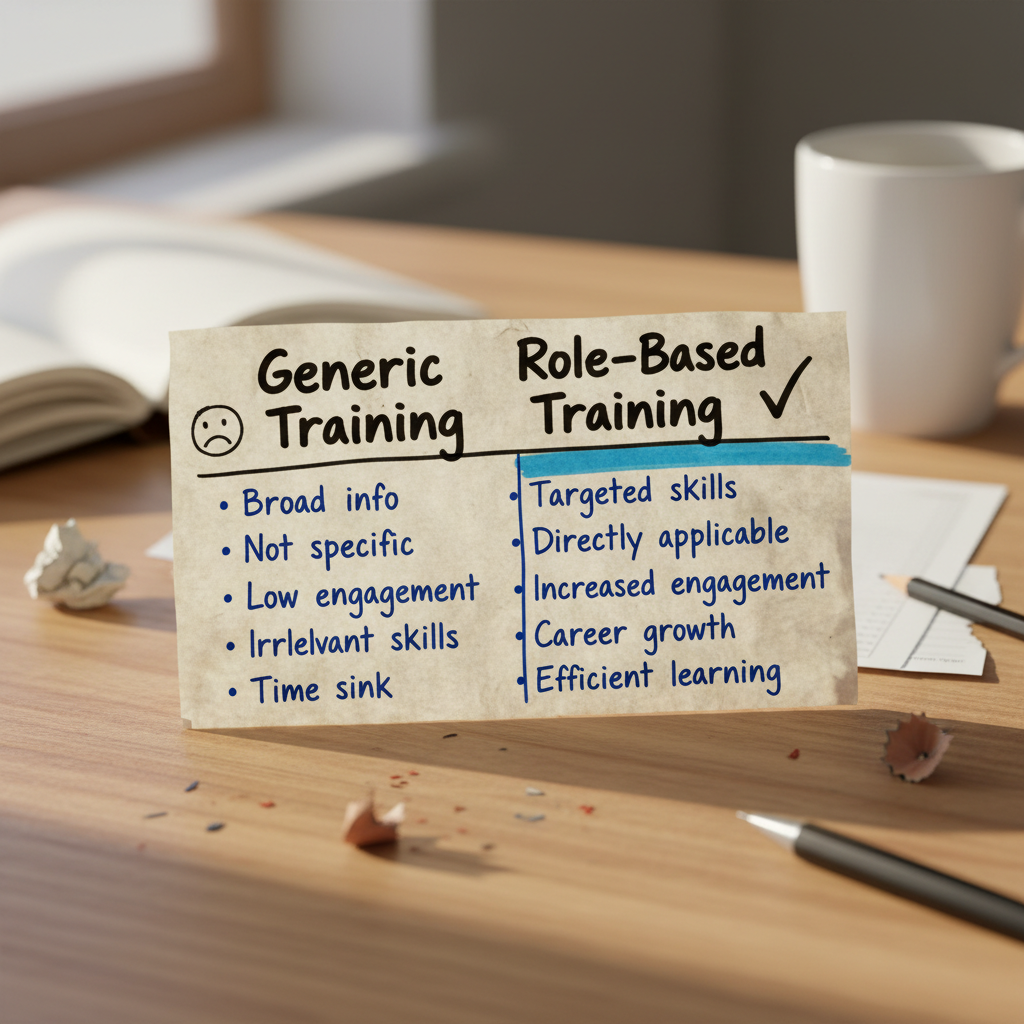
Comparison between generic training and role-based training for workplace AI adoption
The alternative is not more training hours. It is better training design.
At AIHQ, we have seen that role-based AI training creates significantly stronger workplace adoption than generic workshops. The principle is simple: connect every exercise to a real task the employee performs weekly.
Here is how a structured, role-based approach differs in practice.
Start with the Workflow, Not the Tool
Instead of opening with ChatGPT features, a role-based programme starts with the employee's actual workflow. What tasks take the most time? What tasks feel repetitive? Where do bottlenecks happen?
For an HR executive, the pain point might be drafting offer letters, comparing benefit plan options or summarising performance review notes. For a finance analyst, it might be reconciling variance reports, drafting budget commentary or summarising audit findings.
Once the workflow is mapped, the training shows how AI can support those specific tasks. The employee leaves not with a general skill, but with a repeatable habit tied to their daily work.
Build Role-Specific Exercises
A practical AI training programme develops different exercises for different departments.
- Marketing teams practice using AI for campaign briefs, audience personas and content calendar planning.
- Procurement teams practise drafting RFQ evaluation summaries, comparing vendor proposals and generating negotiation briefs.
- Customer service teams practise drafting responses to common enquiries, summarising complaint histories and escalating complex cases with better context.
Each exercise mirrors a real task. The employee can use it immediately after the session.
Include Responsible Use Within the Role Context
Generic training often covers responsible AI use as a separate slide. Role-based training weaves it into the workflow.
When an HR executive learns to draft a sensitive communication using AI, the training includes a discussion about confidentiality and data boundaries. When a finance analyst summarises financial data, the training covers accuracy checks and human review requirements.
This embeds responsible use as a practical habit rather than an abstract policy.
Why This Matters for Malaysian Organisations
Malaysia's AI adoption landscape is unique. Our workforce spans traditional industries like manufacturing and palm oil, regulated sectors like banking and takaful, and a growing digital services economy. Each sector has different workflow needs and different comfort levels with technology.
A generic AI course designed for a Silicon Valley startup will not serve a Malaysian GLC with strict governance requirements. A finance team at a Malaysian bank needs training that acknowledges regulatory oversight. A public sector department needs examples relevant to civil service workflows.
Localisation is not just about language. It is about institutional context, regulatory awareness and cultural workflow preferences.
AIHQ has designed and delivered role-based AI training for organisations across corporate, public sector and professional environments in Malaysia. We have worked with teams in media, finance, property, government and professional services. Each programme is tailored to the roles, workflows and challenges of the participants.
A Framework for Choosing the Right AI Training
When evaluating an AI training provider, ask these questions:
Does the training differentiate by role? If all participants receive the same exercises regardless of their job function, adoption will suffer.
Are the examples locally relevant? Does the training reference Malaysian business scenarios, workflows and institutional contexts?
Is there a follow-through mechanism? What happens after the workshop ends? Is there support for embedding the skills?
Does the training address responsible use? Are data boundaries, accuracy checks and human review discussed within the context of each role?
Can the training be linked to your organisation's specific workflows? The best AI training starts by understanding your workflows before designing the curriculum.
Beyond Training: When Off-the-Shelf Tools Need More
Some organisations discover after training that the off-the-shelf AI tools are not enough for their specific workflow needs. A legal department handling confidential documents may need an internal system where data never leaves the organisation. An operations team managing complex approval workflows may need a custom automation.
In these cases, training alone is not the answer. Organisations may benefit from exploring custom AI solutions that integrate directly into their existing workflows. AIHQ supports this stage when off-the-shelf tools reach their limits.
The Bottom Line
Generic AI training creates attendance, not adoption. For organisations serious about building workforce AI capability, the training must be role-specific, context-driven and tied to real workflows.
The question is not whether your employees can learn to prompt an AI tool. The question is whether they can apply AI to the work they actually do every day.
For HR and L&D leaders planning their next capability initiative, the most important decision is not which tool to teach, but how the training connects to the desk.
Frequently Asked Questions
Why does generic AI training fail to create adoption?
Generic training treats all employees the same, uses examples disconnected from real workflows and lacks follow-through mechanisms. Employees attend but cannot apply the learning to their actual daily tasks.
What is role-based AI training?
Role-based AI training designs exercises around each department's actual workflows. A marketing team practises campaign drafting, while a finance team works on budget commentary. Every exercise mirrors a real task.
How long does it take for employees to adopt AI after training?
Adoption depends on training design, reinforcement and manager support. Role-based programmes with follow-through mechanisms typically see stronger usage within weeks compared to single workshops.
Is role-based AI training available for small teams?
Yes. Role-based training can be designed for small teams or even individual departments. The approach scales to the size and needs of the group.
Can AI training be structured for HRDC claims?
AIHQ is a registered HRD Corp training provider. Programmes can be structured to be HRDC claimable, subject to client eligibility, grant approval and HRD Corp submission requirements.
What happens if our team needs more than off-the-shelf AI tools?
Some workflows require custom AI solutions such as internal copilots, knowledge systems or workflow automation. AIHQ can help explore whether a custom solution is appropriate for your needs.
Ready to move beyond generic AI training? If your organisation is looking for structured, role-based AI capability building that connects to real workflows, AIHQ can help design a programme aligned with your teams, roles and business priorities.
FAQ
Why does generic AI training fail to create adoption?
Generic training treats all employees the same, uses examples disconnected from real workflows and lacks follow-through mechanisms. Employees attend but cannot apply the learning to their actual daily tasks.
What is role-based AI training?
Role-based AI training designs exercises around each department's actual workflows. A marketing team practises campaign drafting, while a finance team works on budget commentary. Every exercise mirrors a real task the employee performs weekly.
How long does it take for employees to adopt AI after training?
Adoption depends on training design, reinforcement and manager support. Role-based programmes with follow-through mechanisms typically see stronger usage within weeks compared to single generic workshops.
Is role-based AI training available for small teams?
Yes. Role-based training can be designed for small teams or even individual departments. The approach scales to the size and needs of the group.
Can AI training be structured for HRDC claims?
AIHQ is a registered HRD Corp training provider. Programmes can be structured to be HRDC claimable, subject to client eligibility, grant approval and HRD Corp submission requirements.
What happens if our team needs more than off-the-shelf AI tools?
Some workflows require custom AI solutions such as internal copilots, knowledge systems or workflow automation. AIHQ can help explore whether a custom solution is appropriate for your needs.